
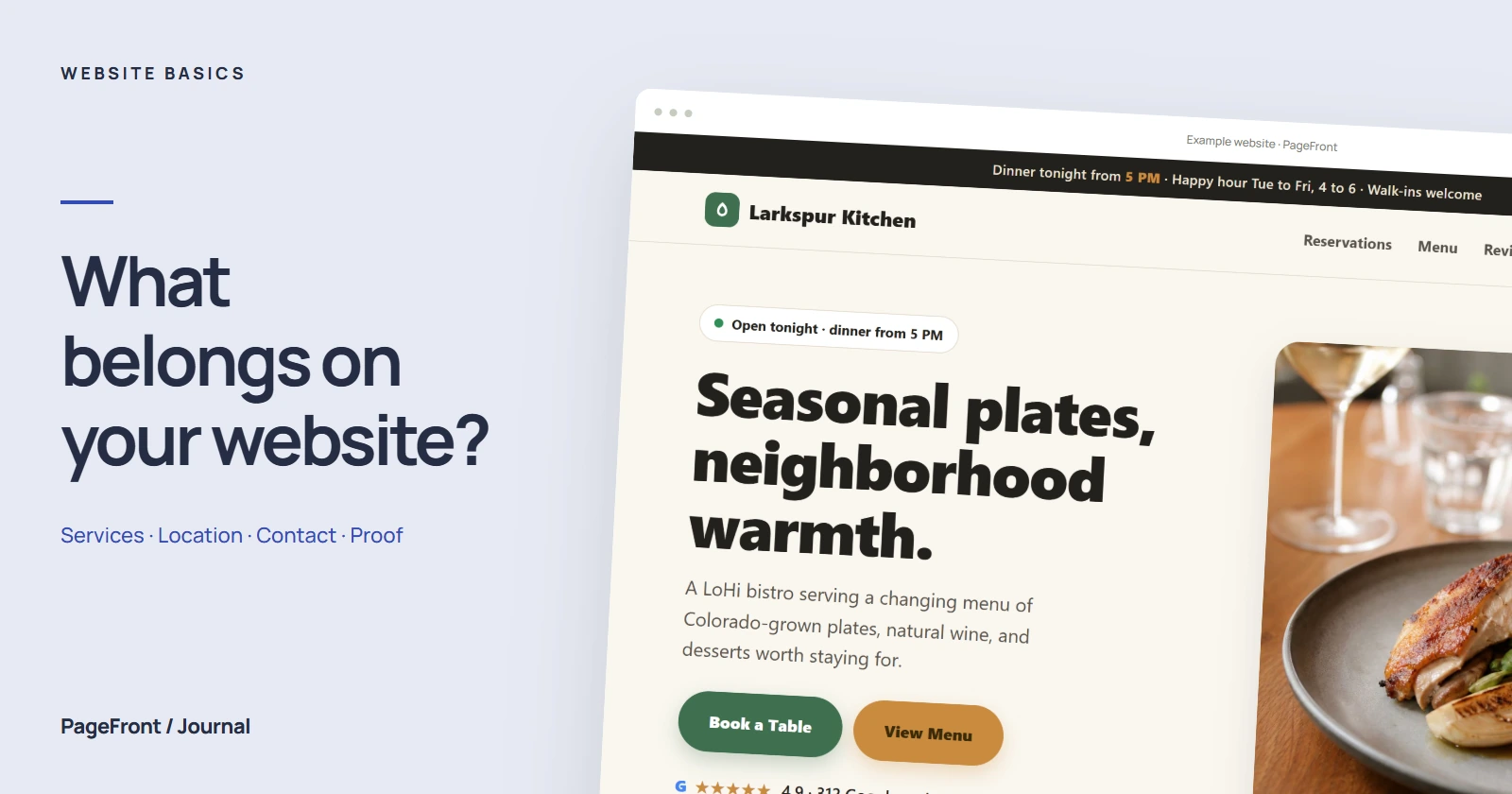
A small business website should quickly answer three questions: what do you do, where do you serve, and how can a customer take the next step?
Everything else should support those answers with trust, clarity, and proof.
The must-have pieces
A good website does not need to be huge. It needs to be complete enough that a new customer feels comfortable calling, booking, ordering, or requesting a quote.
- Business name and short description
- Services, menu, packages, or products
- City, location, or service areas
- Phone, booking, quote, order, or contact form
- Hours, directions, or appointment information
- Photos of the work, space, team, or results
- Reviews, credentials, guarantees, or trust signals
- FAQ answers for common hesitations
The homepage should make the next step obvious
Do not make customers hunt. The main button should match how you actually want leads to come in. A salon may need Book Online. A contractor may need Request a Quote. A restaurant may need Order Online or View Menu.
What can wait until later
You do not need every page on day one. Many businesses can start with a strong one-page site and add service pages, galleries, blog posts, or location pages later.
| Start with | Add later |
|---|---|
| Services and CTA | Individual service pages |
| Photos and reviews | Full gallery |
| Hours and location | Location pages |
| FAQ | Blog or resource section |
What PageFront does differently
PageFront turns your intake form into these core website sections, then fills gaps with sensible defaults for your business type.
Want the simple path?
Send your business details and PageFront will build a free website draft. You decide if you want to keep it live.
Start your free website draft