
Why Professional Service Websites Need Clear Next Steps
Professional service clients rarely arrive ready to commit. They may have a question, a problem, or a short list of firms. A clear next step lets them move forward without guessing what happens after they click.
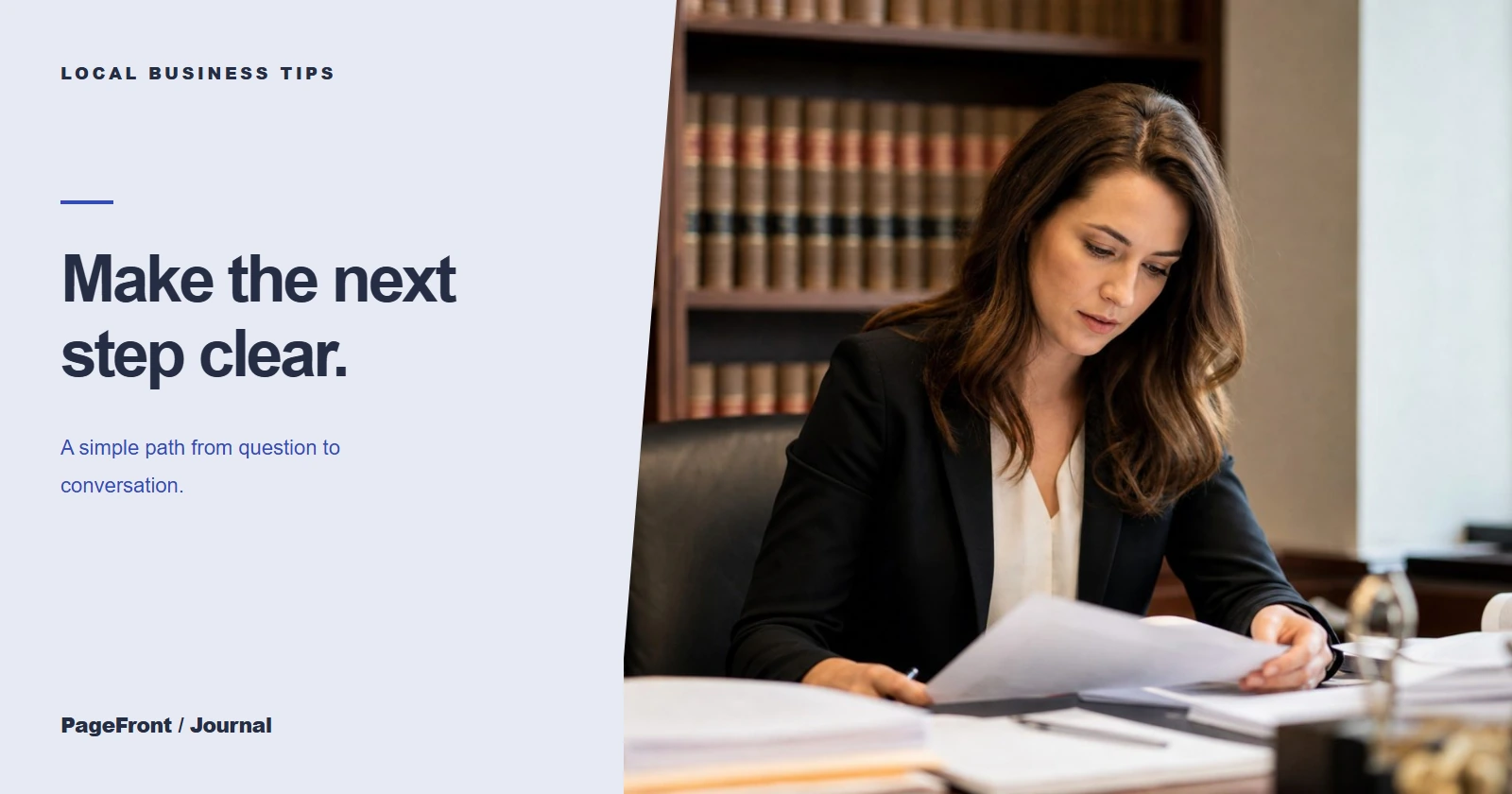
Say what a visitor can do next
A vague “Contact” button makes people do extra work. Give the action a useful name: “Ask about your situation,” “Request a consultation,” or “Get a project estimate.” The best wording describes the first conversation, not the entire engagement.
Place that action near your main promise, after key proof, and at the end of each service page. Repeating one familiar action gives a visitor a dependable route forward wherever they enter the site.
Make the first action feel low pressure
Many clients are still deciding whether their issue needs help. Explain what happens after they reach out, what information is useful, and when they can expect a reply. If you offer a call, say whether it is a brief fit check, an intake conversation, or a consultation.
Keep the form short. Name, email or phone, and a sentence about the need is often enough. Long forms can ask for sensitive details too early and turn a simple inquiry into a chore.
Match the action to the page
Service pages should lead to a service-specific conversation. An accountant’s tax-planning page might invite a visitor to “Ask about tax planning.” A law firm’s practice-area page might offer “Discuss your situation.” This shows visitors that their reason for visiting was understood.
Use plain words and avoid promises you cannot make. A professional website can be reassuring without claiming a guaranteed outcome. For a broader foundation, review what a small business website should include and what makes a local business website feel trustworthy.
Remove competing paths
Phone, email, and an office address can all be useful, especially for established clients. But they should not compete with the main action at every turn. Choose one primary next step, then present other contact details as supportive options.
Check the mobile version too. A visitor should be able to understand the action, tap it, and complete it without pinching, hunting, or opening a confusing third-party page.
Start with a website you can actually use
Clear next steps work best when the rest of the page earns the click: a straightforward explanation, relevant services, local proof, and current contact details. You can refine the wording as you learn what prospects ask most often.
PageFront builds simple websites for small local service businesses. Review a free website draft, then keep it live from $39/mo with no upfront design fee, no contract, and no sales call. See our law firm demo or website examples for practical layouts.
Make the first step easy.
See a clear, professional website draft for your local business.
Start your free website draftFrequently asked questions
What is a clear next step on a professional service website?
It is one specific action a ready visitor can understand immediately, such as request a consultation, ask a question, or book an introductory call.
Should every page use the same call to action?
The action can stay consistent, but the wording should fit the page and the visitor’s context.
How many call-to-action buttons should a service website have?
Use one primary action repeatedly and keep secondary options quiet so visitors can decide without friction.
Can PageFront build a professional service website?
Yes. Review a free draft, then keep it live from $39 per month with no upfront design fee, no contract, and no sales call.